Architecture
This section is organized by responsibility so cross-cutting engine topics live at the top level and component internals stay grouped under dedicated section indexes.
High-level system view
HestiaStore is organized around a SegmentIndex orchestration layer that
routes operations across stable segments, keeps hot segment state in memory, and
exposes runtime metrics without letting monitoring code touch index files
directly.
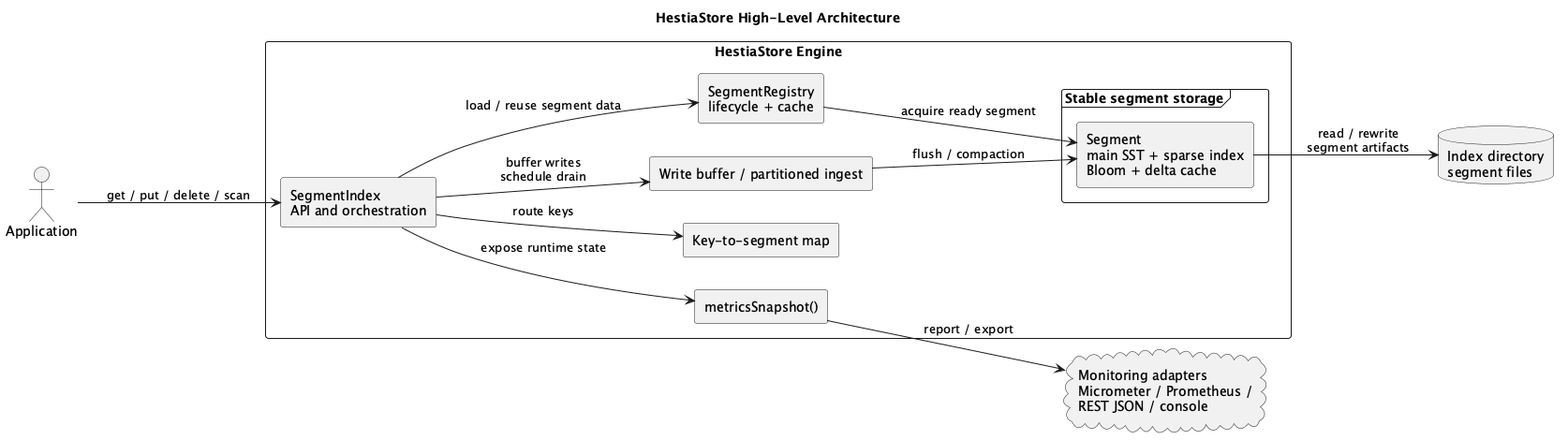
Source: system-overview.plantuml
Main runtime components
- SegmentIndex is the public engine entry point. It owns request routing, direct routed writes, flush/compaction scheduling, split orchestration, and runtime metrics.
- Key-to-segment map resolves which segment should serve a key range so the index can route reads and writes without scanning every segment.
- SegmentRegistry is the lifecycle and cache boundary between
SegmentIndexand loaded segment data. It decides when segment resources are created, reused, evicted, and closed. - Segment is the stable storage shard. A segment combines a main SST, a sparse index, a Bloom filter, and delta cache files to balance write cost and lookup latency.
- Monitoring adapters consume
SegmentIndex.runtimeMonitoring().snapshot()and runtime management APIs. They observe the engine, but they do not read or rewrite segment files directly.
High-level data flow
- Write path: requests enter
SegmentIndex, are routed to one stable segment, and become immediately visible through that segment's write cache; flush and compaction later persist the segment state. - Read path:
SegmentIndexroutes a key through the key-to-segment map, obtains the target segment through the registry, and then reads segment structures such as delta cache, Bloom filter, sparse index, and main SST. - Observability path: monitoring integrations read immutable runtime snapshots from the engine and expose them through REST JSON or external metrics systems.
Cross-cutting topics
- Data Block Format — low-level block and chunk structure.
- Filters & Integrity — chunk filter pipeline and validation.
- Chunk Filter Provider Model — how filter specs, providers, registries, and runtime suppliers fit together.
- Chain of Filters — shared filter-chain helper.
- Concurrency Model — index-wide synchronization model.
- Consistency & Recovery — crash-safety and recovery model.
- Package Layout — module/package layout and dependency contracts.
- Limitations & Trade-offs — current constraints and risks.
- Glossary — shared terminology.
Component sections
- Monitoring — runtime monitoring bridge and management API contracts.
- SegmentIndex — top-level index orchestration: read/write paths, caching, performance, and index concurrency.
- Segment — central place for segment internals: file layout, delta cache, Bloom filter, sparse/scarce index, and segment lifecycle.
- Registry — segment registry state machine, cache-entry model, and concurrent loading/unloading flows.