Segment Registry
This document describes the segment registry responsibilities and supported operations.
Scope
- The registry owns:
- safe access to segment resources (load/delete)
- in-memory segment cache (LRU)
- registry-level state gate (
READY,CLOSED,ERROR,FREEZE) - segment id allocation for new segments via a
Supplier<SegmentId> - physical deletion of normal, retired, and unpublished prepared segments
- The registry does not own protection of "segment in use" vs "segment close/delete" races. This responsibility belongs to the Segment package. Segment implementations must remain safe when one thread uses a segment while another thread closes it.
- The registry does not own split execution, scheduling, or in-flight tracking. Those belong to the segment index layer.
- The registry is about safe access to segment resources and now exposes
BlockingSegmentas the main public access point for loaded segments. BlockingSegmentcentralizes retry-aware blocking operations and segment runtime descriptors, while callers still own higher-level operation policy such as fail-fast routing, split coordination, and accepted-vs-completed maintenance behavior.- Registry internals use the shared
OperationResult<T>andOperationStatusprotocol. The publicSegmentRegistryfacade translates those statuses into blocking results,Optional,boolean, orIndexException, depending on the selected operation. - A missing segment directory is currently treated as
BUSY. Consequently,loadSegment()retries until its busy timeout, whiletryGetSegment()returns an empty result.
Registry State Machine
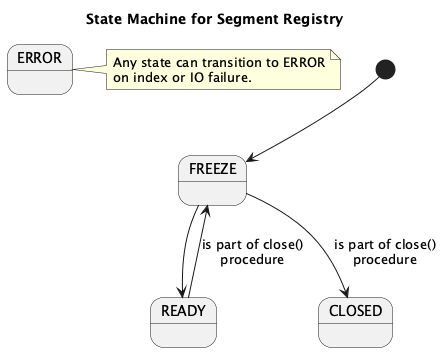
The registry state machine starts in FREEZE. SegmentRegistryImpl
transitions it to READY during registry construction. This occurs when
SegmentIndexBootstrapOperation opens the registry, before the remaining
SegmentIndex runtime services and startup completion steps are assembled.
Transitions
| Original State | New State | When |
|---|---|---|
READY |
FREEZE |
is part of close() procedure |
FREEZE |
READY |
registry construction completes |
FREEZE |
CLOSED |
index closing while frozen (close()) |
| any | ERROR |
unrecoverable registry failure (fail()) |
Rules
- Status-based load and delete operations are state-gated:
READY-> normal flow,FREEZE->BUSY,CLOSED->CLOSED,ERROR->ERROR. - Materialization and runtime-limit mutations require
READYand throwIndexExceptionin every other registry state. Loaded-segment runtime snapshots return an empty list outsideREADY. - In
READY, loading and deletion can still returnBUSYon cache entry state conflict. - A segment close failure is not a cache conflict. The cache cancels the unload,
restores the entry to
READY, and propagates the failure. Delete operations reportERROR; registry close throwsIndexExceptionwith the close failure as its cause. close()is idempotent and movesREADYtoFREEZEand then toCLOSED.- Registry close attempts every cached entry before reporting accumulated close failures.
ERRORis terminal for the state machine;close()does not transitionERRORtoCLOSED.
Registry Operations
| Operation | Description |
|---|---|
loadSegment(id) |
Load or return a cached BlockingSegment, retrying BUSY up to timeout. |
tryGetSegment(id) |
Attempt one load; return empty for BUSY or CLOSED. |
tryGetLoadedSegment(id) |
Return an already cached segment without loading it. |
deleteSegment(id) |
Close and delete a segment, retrying BUSY up to timeout. |
deleteRetiredSegment(id) |
Delete an unreachable split parent using forced cache invalidation. |
deleteSegmentIfAvailable(id) |
Attempt one deletion and report false when the segment remains busy. |
metricsSnapshot() |
Return immutable registry-cache counters. |
updateCacheLimit(limit) |
Apply a positive cache limit while the registry is ready. |
materialization() |
Expose READY-gated segment-id allocation and prepared writer transactions. |
runtime() |
Expose READY-gated runtime tuning and loaded snapshots; snapshots are empty outside READY. |
close() |
Close cached segments and transition the registry gate. |
The public facade returns BlockingSegment instances so the registry remains
the central access point for retry-aware segment operations. These blocking
segments translate retryable segment-operation outcomes (BUSY, transient
CLOSED) into bounded blocking calls while preserving the existing segment
state machine and background-maintenance semantics. flush() and compact()
on the handle block only until the request is accepted; they do not wait for
the background maintenance work to reach READY.
BlockingSegment.getRuntime().getState() observes a closed generation with
one registry lookup. It refreshes the cached generation when a replacement is
available and leaves the cached generation unchanged when the lookup returns
BUSY or CLOSED. A concurrent refresh can still supply a newer generation.
This lets maintenance observe completion after a split retires its parent.
Data operations continue to use their bounded blocking reload policy.
Single-attempt operations on BlockingSegment return the shared
OperationResult<T>. Blocking handle operations retry retryable statuses and
throw IndexException on timeout or terminal failure. The primary registry
safety model is the registry state gate plus the per-key cache entry state
machine, not caller-side pinning.
Response Codes
Registry internals use the shared OperationStatus values with these semantics:
| Code | Description |
|---|---|
OK |
Segment returned or operation accepted. |
BUSY |
Temporary refusal (cache entry state conflict, UNLOADING, or registry is FREEZE). |
CLOSED |
Registry closed; no further operations. |
ERROR |
Terminal operation failure, including a segment close or filesystem deletion failure. |
The public facade translates these statuses as follows:
loadSegment()retriesBUSYand throwsIndexExceptionon timeout,CLOSED, orERROR.- Blocking delete operations retry
BUSY, treatCLOSEDas already deleted, and throwIndexExceptionon timeout orERROR. tryGetSegment()returns empty forBUSYandCLOSED, and throws forERROR.deleteSegmentIfAvailable()returnsfalseforBUSY;CLOSEDis treated as already deleted.- A missing segment directory follows the
BUSYpath rather than producing a distinct not-found orERRORresult.
Registry Cache Entry
This section describes the implemented cache-entry model.
Entry operations
| Operation | Entry state precondition | Outcome | Used by |
|---|---|---|---|
tryStartLoad() |
MISSING |
Attempts to start load for the key by transitioning to LOADING for the winning caller. Returns not-started when another entry already exists. |
SegmentRegistryCache.get() miss path |
waitWhileLoading(currentAccessCx) |
Any | Waits while LOADING Returns value in READY, any exceptions in propagated. up |
SegmentRegistryCache.get() |
finishLoad(value) |
LOADING |
Stores value, transitions to READY, signals waiters. |
cache load winner |
fail(exception) |
LOADING |
Stores failure, marks entry failed/unloading path, signals waiters; map entry is removed by cache loader error path. | cache loader error path |
tryStartUnload() |
READY with value |
Attempts atomic transition to UNLOADING. Returns true when unload was started, false otherwise. |
eviction and invalidate() |
finishUnload() |
UNLOADING |
Clears value and signals waiters; entry is then treated as missing by readers. | eviction and invalidate() finalization |
getEvictionOrder() |
Any | Returns LRU order only for unloadable READY entry; otherwise returns sentinel (Long.MAX_VALUE). |
LRU candidate selection |
waitWhileLoading(currentAccessCx) blocks only while the entry is in LOADING.
It does not wait for UNLOADING; that case must be handled by higher-level
caller logic, because an unloaded entry is no longer valid.
Per-key Entry state machine
Each cache key owns one Entry object with an independent lock/condition.
Only threads touching the same key can block each other.
States
| State | Description |
|---|---|
LOADING |
Entry was atomically installed with putIfAbsent(key, Entry{LOADING}); winner thread loads value. |
READY |
Value is available; get(key) returns the value immediately and updates recency. |
UNLOADING |
Value is being closed/unloaded and entry is no longer usable for normal reads. |
MISSING is a virtual state: it means no entry was found in cache for the key yet, but an entry can still be instantiated by the loading path.
Transitions
| From | To | Trigger |
|---|---|---|
MISSING |
LOADING |
Winning caller starts load (tryStartLoad()). |
LOADING |
READY |
Loader completes successfully and signals waiters. |
LOADING |
MISSING |
Loader fails; entry is removed and waiters are signaled with failure. |
READY |
UNLOADING |
Eviction/delete starts unload (tryStartUnload()). |
UNLOADING |
READY |
Segment close fails; unload is cancelled and the failure propagates. |
UNLOADING |
MISSING |
Unloader completes and entry is removed from cache. |
Guarantees
- At most one loader runs per key.
- Wait/notify is per key (
Entry), not global. - Keys with different
Entryinstances progress independently. - Unload is started by direct per-entry transition (
READY -> UNLOADING), not by reference pin counting.
Thread model
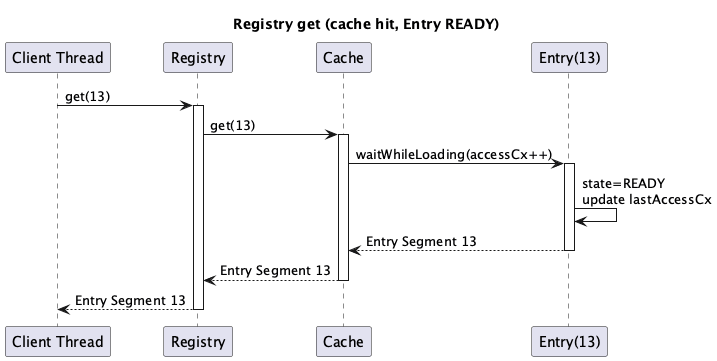
1. Registry load with cached segment
2. Registry load with cached entry in LOADING state
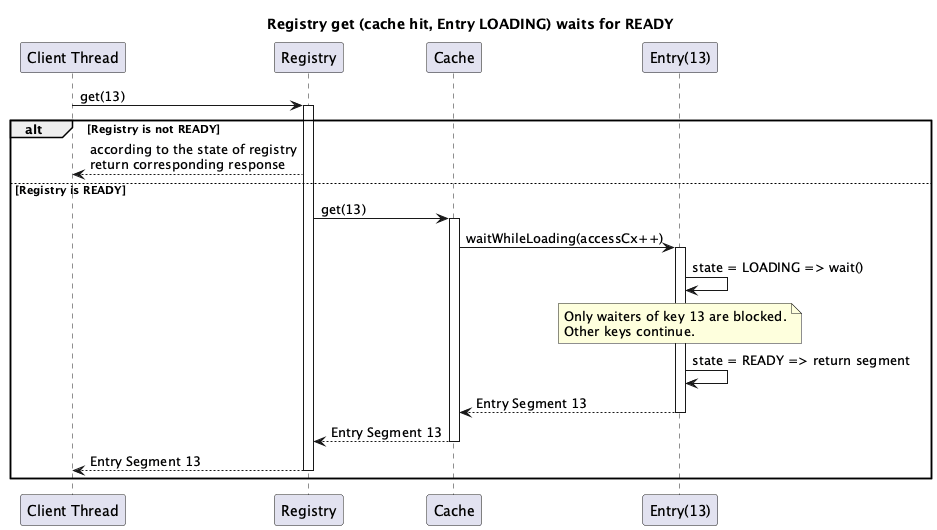
When the registry entry exists in cache but is still LOADING, the cache waits until loading finishes before returning it. When the entry is UNLOADING, the registry treats it as temporarily unavailable and returns BUSY. The flow is shown below:
3. Registry load cache miss with putIfAbsent(LOADING)
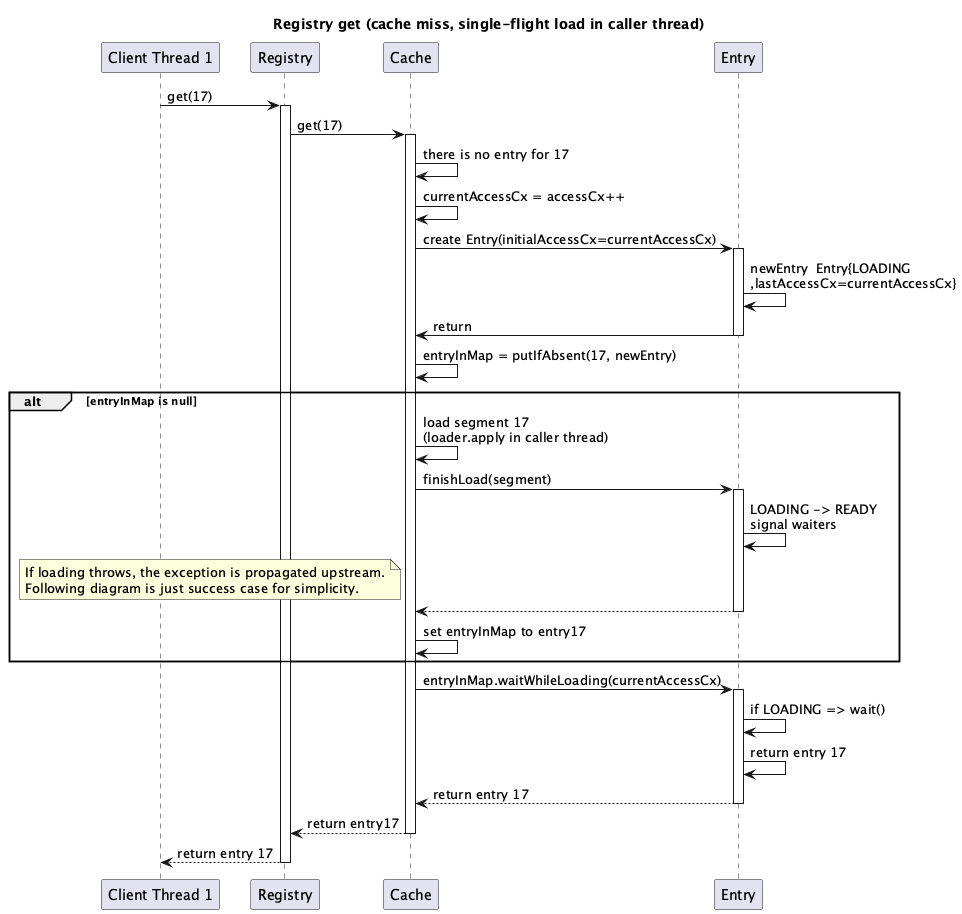
The winning caller loads the segment in its own thread.
4. Synchronous LRU eviction
Capacity pressure selects the least-recently-used unloadable entry and closes
it in the loading caller's thread. Successful close removes the old entry and
reserves the slot for the new load. Failed close restores the old entry to
READY; the load fails with an IndexException whose cause identifies the
close failure.
deleteSegment(id) flow
- Try to transition the cached entry to
UNLOADING; returnBUSYwhen the entry is not unloadable. - Close the segment with retry/backoff until it is
CLOSEDor returnsOK. - Delete the segment directory and files on disk.
- Remove the unloaded entry from cache memory.
A close failure cancels the unload and produces ERROR; it is not reported as
BUSY. SegmentImpl logs the original exception at the point where the
segment core close fails.
When the segment is not cached, deletion is best‑effort and only touches disk. Prepared split rollback uses this same registry deletion path, so unpublished children are invalidated from the cache before their directories are removed.