Configuration Flow
This page describes how HestiaStore turns a user configuration request into the
effective configuration used by storage, runtime services, and execution
packages. The package relationship diagram below is intentionally scoped to
the user data path from SegmentIndex calls to Segment operations.
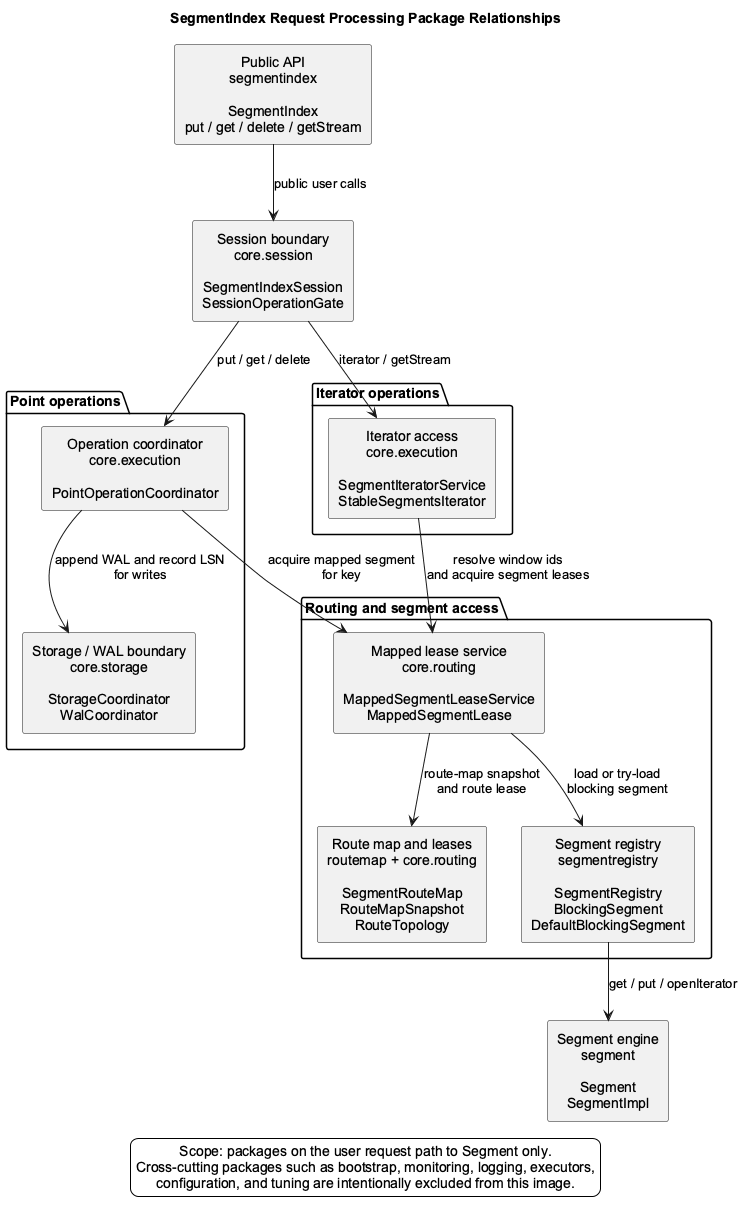
Source: configuration-flow.plantuml
Diagram Scope
Keep package relationship images focused on packages that process user data
requests to segments: put, get, delete, and iterator or stream paths.
Do not include broad cross-cutting packages such as bootstrap, monitoring,
logging, executors, configuration, or tuning unless the image is specifically
about one of those concerns. Those packages relate to many other packages and
can hide the request path.
Configuration Layers
There are three separate responsibilities:
configuration.user
Public request objects live here. IndexConfiguration and its section
builders describe what the caller asked for. Section values may be null;
null means no override was requested.
configuration.effective
Runtime-ready values live here. EffectiveIndexConfiguration contains fully
resolved values for identity, segment limits, write-path limits, Bloom
filter settings, maintenance, I/O, logging, WAL, filter pipelines, runtime
tuning, and chunk-store cache limits.
configuration.persistence
Persistence code lives here. IndexConfigurationManager coordinates create
and open resolution. IndexConfigurationStore stores the effective
configuration in manifest.txt through IndexPropertiesSchema.
Runtime and storage code should consume EffectiveIndexConfiguration, not
IndexConfiguration.
Create Flow
On create, EffectiveIndexConfigurationResolver.resolveForCreate(...):
- requires key class, value class, and index name
- chooses defaults from
IndexConfigurationDefaultsRegistryorIndexConfigurationDefaults - resolves key and value type descriptor names
- computes derived segment and write-path values
- resolves Bloom filter, maintenance, I/O, logging, WAL, filters, and chunk-store cache sections
- returns an
EffectiveIndexConfiguration
The bootstrap flow stores this effective configuration in the bootstrap state.
SegmentIndexBootstrapOperation then persists it when the resolution says a
write is required.
Open Flow
On open, IndexConfigurationManager.resolveForOpen(...):
- loads the stored effective configuration from
manifest.txt - merges the new user request with the stored configuration
- rejects changes to fixed persisted properties
- writes the merged effective configuration only when the merge changed a persisted value
The current resolver rejects changes to fixed identity, layout, Bloom filter, filter pipeline, and WAL values. The fixed checks cover key/value classes, type descriptors, segment size, chunk size, Bloom filter settings, chunk filters, and WAL configuration.
The current resolver applies reopen-time overrides for selected runtime-facing
values such as segment cache size, segment write-cache limits, maintenance
settings, I/O buffer size, logging, delta-cache file limit, chunk-store cache
limit, and index name. It keeps the stored segmentSplitKeyThreshold during
open.
Bootstrap Application
SegmentIndexBootstrapOperation applies the effective configuration before and
during runtime construction. The key configuration-consuming actions are:
- resolve or merge the effective config
- instantiate key and value descriptors from
identity - persist the effective config when needed
- map maintenance and logging settings to runtime executors
- create the parsed chunk page cache
- pass the effective config into the segment registry builder
- create storage services and
RuntimeTuningState - wire topology, split, streaming, and operation services
- open WAL resources and bind storage WAL coordination when WAL is enabled
- wire maintenance, metrics, monitoring, and runtime tuning
- use
logging.contextEnabled()andidentity.name()to wrap the runtime index when context logging is enabled
After this point, execution packages receive concrete runtime collaborators that were built from the effective configuration.
Runtime Package Mapping
core.executorregistry:
Uses identity, logging, and maintenance to define executor names, context
logging, thread counts, and shutdown timeout.
chunkstorecache:
Uses chunkStoreCache.pageLimit() to create the index-scoped parsed chunk page
cache.
core.storage:
Uses maintenance timing values with the route map, segment registry, and type
descriptors to create the storage service. SegmentIndexBootstrapOperation
also creates RuntimeTuningState from the effective configuration and stores
it in OpenedStorageRuntime.
segmentregistry:
Uses the effective configuration, type descriptors, executors, and chunk page
cache to create the registry. The registry builder and SegmentFactory read
segment, write-path, Bloom filter, I/O, logging, filter, maintenance, and
chunk-store cache sections.
segment through SegmentFactory:
Passes segment, writePath, bloomFilter, io, logging, filters,
chunkStoreCache, and maintenance background mode to SegmentBuilder and the
segment maintenance policy.
core.storage WAL coordination:
Uses the WalRuntime opened by bootstrap to choose a disabled coordinator or
active WAL coordinator. Active coordination also reads WAL retention limits.
configuration.tuning:
Uses runtimeTuning to seed runtime tuning state. Tuning changes are applied to
registry cache limits, loaded segments, and the chunk-store cache limit, then
persisted back through IndexConfigurationStore.
metrics and runtimemonitoring:
Include effective configuration in runtime metrics and monitoring snapshots.
Extension Rules
When adding or changing configuration:
- Add or update the public request section in
configuration.user. - Add or update the resolved section in
configuration.effective. - Define create defaults and open merge rules in
EffectiveIndexConfigurationResolver. - Persist stable values through
IndexConfigurationStoreandIndexPropertiesSchema. - Apply the effective value in the runtime package that owns the behavior.
- Keep execution packages dependent on effective values, not nullable user requests.
- Add tests for create resolution, open merge behavior, persistence round-trip, invalid fixed-property overrides, and the runtime consumer.
Filter configuration is a special case: persisted state stores filter specs,
not runtime suppliers. Runtime suppliers are reconstructed through the
configured ChunkFilterProviderResolver.