Segment Index Concurrency & Lifecycle
Glossary
- Segment index: top-level API that routes operations to segments.
- Key-segment mapping: map of max key -> SegmentId (SegmentRouteMap).
- Mapping version: monotonically increasing counter for optimistic mapping checks.
- Segment topology: runtime route state (
ACTIVE,DRAINING,RETIRED) plus in-flight route leases for mapped segment ids. - Segment lease service: boundary that combines route snapshots, runtime route
leases/drains, and registry segment loading into scoped
MappedSegmentLeaseandRouteSplitLeaseobjects. - Segment registry: cache of Segment instances plus the maintenance executor.
- Split service: accepts split hints, full-scan requests, quiescence waits, and lifecycle shutdown for the managed split runtime.
- Split policy coordinator: owns candidate deduplication, periodic reconciliation, threshold checks, and admission into split execution.
- Split execution coordinator: owns split execution admission, cooldowns, and split-publish exclusivity once a candidate was already admitted.
- Split: replace one routed segment range with child ranges and update the route map atomically.
Core Rules
- SegmentIndex is thread-safe by contract; calls may be concurrent.
- Target: highly concurrent SegmentIndex API; avoid global synchronization and only protect minimal shared structures (mapping updates, split swaps).
- Index operations are not globally serialized; concurrency is bounded by mapping updates, route-topology leases, and per-segment state machines.
- Segment maintenance IO runs on the segment maintenance executor.
- The segment maintenance executor is supplied by
HestiaStoreRuntime(default 10 workers). - Automatic post-write flush/compact is optional and enabled by default.
- Segment BUSY is treated as transient and retried internally; callers do not see BUSY.
- Mapping changes are applied atomically and validated by version checks.
Thread Safety Mechanisms
- IndexInternalConcurrent executes sync operations on caller threads without a global executor.
- SegmentRegistrySynchronized serializes access to the segment instance map and registry mutations.
- SegmentRouteMap publishes the immutable routes and mapping version together through one volatile snapshot. Foreground snapshot and version reads do not take the route-map lock; updates take the write lock and publish the next snapshot after the mutation.
- RouteTopology is rebuilt from the persisted map on startup and reconciled after route-map changes. It does not own segment instances or persistence.
- Foreground
put,delete, andgetuseMappedSegmentLeaseServiceto resolve a map snapshot, acquire a matchingRouteTopologyroute lease, load the segment throughSegmentRegistry, and release the route lease when the scoped operation is closed. - Segment implementations are thread-safe; read/write operations proceed in parallel when the segment state allows it.
API Behavior
- put/get/delete: retry on topology drain, stale route-map versions, registry
BUSY, and per-segment BUSY using the segment-access retry settings
(
maintenance().busyBackoffMillis()+maintenance().busyTimeoutMillis()). A segment CLOSED result restarts routing from a fresh snapshot. Timeouts throw IndexException. - flush/compact: start maintenance on each segment and return once accepted; do not wait for IO completion; BUSY retries follow maintenance retry settings.
- flushAndWait/compactAndWait: wait for each segment to return to
READY(orCLOSED); do not call from a segment maintenance executor thread. - getStream: captures a snapshot of segment ids and iterates them using the default segment iterator isolation (FAIL_FAST). An overload allows FULL_ISOLATION for per-segment exclusivity; the stream must be closed to release the segment lock.
- Segment close (sync): once close starts, the segment drains in-flight work
and rejects/blocks new operations until CLOSED. The caller returns only
after locks/resources are released or the segment enters
ERROR. The registry should not reopen a closing segment; attempts should retry until the close completes. The per-segment.lockfile enforces single-open at the directory level.
Maintenance & Splits
- SegmentIndex evaluates split thresholds after successful writes and schedules
follow-up maintenance only when
backgroundMaintenanceAutoEnabledis true. - Successful writes and maintenance follow-ups emit split-service hints or full-scan requests.
- SplitPolicyScheduler performs both hint-driven wakeups and periodic reconciliation, then hands admitted work to SplitTaskCoordinator.
- Admitted splits run on the shared split-maintenance executor; only one split per segment id can be in flight.
- RouteSplitPlanner retries BUSY using split retry settings; timeouts throw.
- SplitPolicyScheduler uses
MappedSegmentLeaseService.tryAcquireMappedSegment(...)to inspect candidate size without combining topology and registry access itself. - SplitTaskCoordinator schedules by
SegmentIdand usesMappedSegmentLeaseService.tryAcquireForSplit(...)to acquire aRouteSplitLease. That lease moves the parent route toDRAINING, waits for existing route leases to finish, verifies the route is still mapped, and loads the parent segment throughSegmentRegistry. - While the parent route is draining, new foreground leases for that parent fail as BUSY and retry; existing leases are allowed to finish.
- After the split lease is acquired, split materialization reads the parent
stable data through
FULL_ISOLATION, materializes child stable segments, and then publishes the child routes through SegmentRouteMap. - After a split, SegmentRouteMap updates the mapping and flushes it to disk.
RouteSplitLease.completeAfterPublish()reconciles RouteTopology from the new snapshot so children becomeACTIVEand the parent route becomesRETIRED, then completes the drain.
Index State Machine
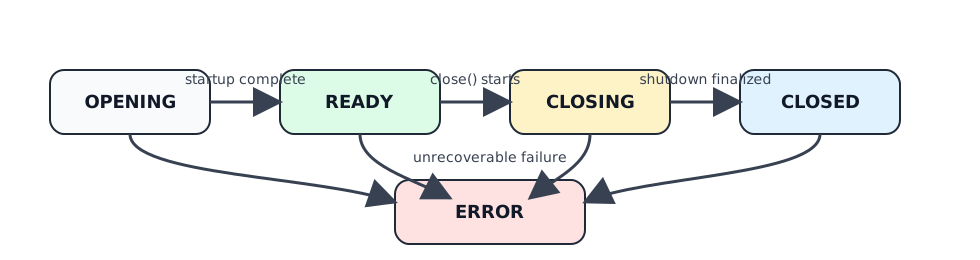
States:
- OPENING: index bootstrap/consistency checks (and lock acquisition) in
progress; operations are rejected.
- READY: operations allowed.
- CLOSING: close() is in progress; new API operations are rejected, the
directory lock is still held, and shutdown may still wait for split/WAL
durability boundaries to settle.
- ERROR: unrecoverable failure; operations are rejected.
- CLOSED: shutdown completed, resources were released, and operations are
rejected.
Transitions:
- OPENING -> READY: after initialization and consistency checks complete.
- READY -> CLOSING: close() starts and begins shutdown coordination.
- CLOSING -> CLOSED: shutdown completes; file lock released.
- any -> ERROR: unrecoverable failure (e.g., OOM, disk full, failed split/file
swap, or consistency check failure).
Notes:
- Only one index instance may hold the directory lock at a time.
- The lock is held through CLOSING and released only when the instance
reaches CLOSED (or during terminal ERROR cleanup).
- flushAndWait() and compactAndWait() remain explicit maintenance
boundaries while close() now uses the same settlement model before
finalizing shutdown.
Failure Handling
- SegmentResultStatus.ERROR from any segment results in IndexException.
- Maintenance failures move the segment to ERROR; flushAndWait/compactAndWait propagate as IndexException.
- Split failures surface through the split future and are rethrown when joined.
- If split materialization or pre-publish validation fails, prepared child
directories are deleted and the
RouteSplitLeaseaborts the parent route drain. - If SegmentRouteMap rejects a split because the parent route is no longer mapped, prepared children are deleted. If the parent is still mapped, the split lease aborts the drain; if another publisher already replaced the parent, the split lease completes the drain after topology reconciliation.
- If route-map persistence, split-lease topology reconciliation, or retired-parent cleanup fails after the in-memory route map has accepted the children, the split failure is fatal. Prepared children are not deleted because the current route map may already reference them.
- Retired parent deletion after publish is best-effort. If the segment is busy, the directory remains orphaned and recovery/consistency cleanup retries deletion through SegmentRegistry.
- Startup rebuilds RouteTopology from the persisted SegmentRouteMap and then deletes segment directories that are not referenced by the persisted map.
- When entering ERROR, the index stops accepting operations and requires manual intervention (recovery/repair or restore from backups).
Components
- SegmentIndex (public API): thread-safe entry point.
- SegmentIndexSession: retries BUSY, routes operations to segments, and manages maintenance.
- MappedSegmentLeaseService: route snapshot, RouteTopology lease/drain acquisition,
SegmentRegistry loading, and scoped
MappedSegmentLease/RouteSplitLeaseownership. - NonBlockingSegmentOperationGateway: single-attempt stable-segment operation access through SegmentRegistry.
- Named retry policies: backoff + timeout for BUSY retries. Current defaults
come from
maintenance().busyBackoffMillis()andmaintenance().busyTimeoutMillis(). - StableSegmentOperationResult/StableSegmentOperationStatus: internal OK/BUSY/CLOSED/ERROR wrapper for stable-segment operations.
- SegmentRouteMap: mapping, snapshot versioning, and persistence of segment ids.
- RouteTopology: runtime route state and route leases; rebuilt from SegmentRouteMap snapshots.
- SegmentRegistry(Synchronized): caches Segment instances and supplies the maintenance executor.
- SplitRuntime: managed split runtime boundary for hints, full scans, quiescence, metrics, and shutdown.
- SplitPolicyScheduler: split scheduling decisions.
- SplitTaskCoordinator: split execution admission, cooldowns, split
worker scheduling, and
RouteSplitLeaselifecycle. - RouteSplitPlanner: split feasibility check and child materialization.
- RouteSplitPublisher: route-map publish and split cleanup boundaries.
Iterator Isolation
- FAIL_FAST: iteration is optimistic; any mutation can invalidate the iterator and terminate the stream early.
- FULL_ISOLATION: holds exclusive access per segment while its iterator is open; writers, flush/compact, and split on that segment block until the iterator (or stream) is closed.
Implementation Mapping
- Index implementation: IndexInternalConcurrent (caller-thread execution).
- Mapping version: SegmentRouteMap.version (AtomicLong).
- Runtime route version: RouteTopology.version, reconciled from SegmentRouteMap snapshots.
- Maintenance executor: SegmentRegistry.getMaintenanceExecutor() backed by
the
HestiaStoreRuntimesegment-maintenance pool. - Index maintenance pool:
hestia-<indexName>-index-maintenance-*from ExecutorRegistry. - Split policy scheduler:
hestia-<indexName>-split-policy-*from ExecutorRegistry. - Registry maintenance pool:
hestia-<indexName>-registry-maintenance-*from ExecutorRegistry. - WAL append and delayed group sync worker:
hestia-<indexName>-wal-append-*, created byExecutorRegistryand drained byWalRuntimebefore executor shutdown. - Shared segment maintenance pool:
hestia-segment-maintenance-*from HestiaStoreRuntime. - Shared split worker pool:
hestia-split-maintenance-*from HestiaStoreRuntime. - Split isolation: SegmentIteratorIsolation.FULL_ISOLATION.
- Retry policy:
IndexConfiguration.maintenance().busyBackoffMillis()andIndexConfiguration.maintenance().busyTimeoutMillis().